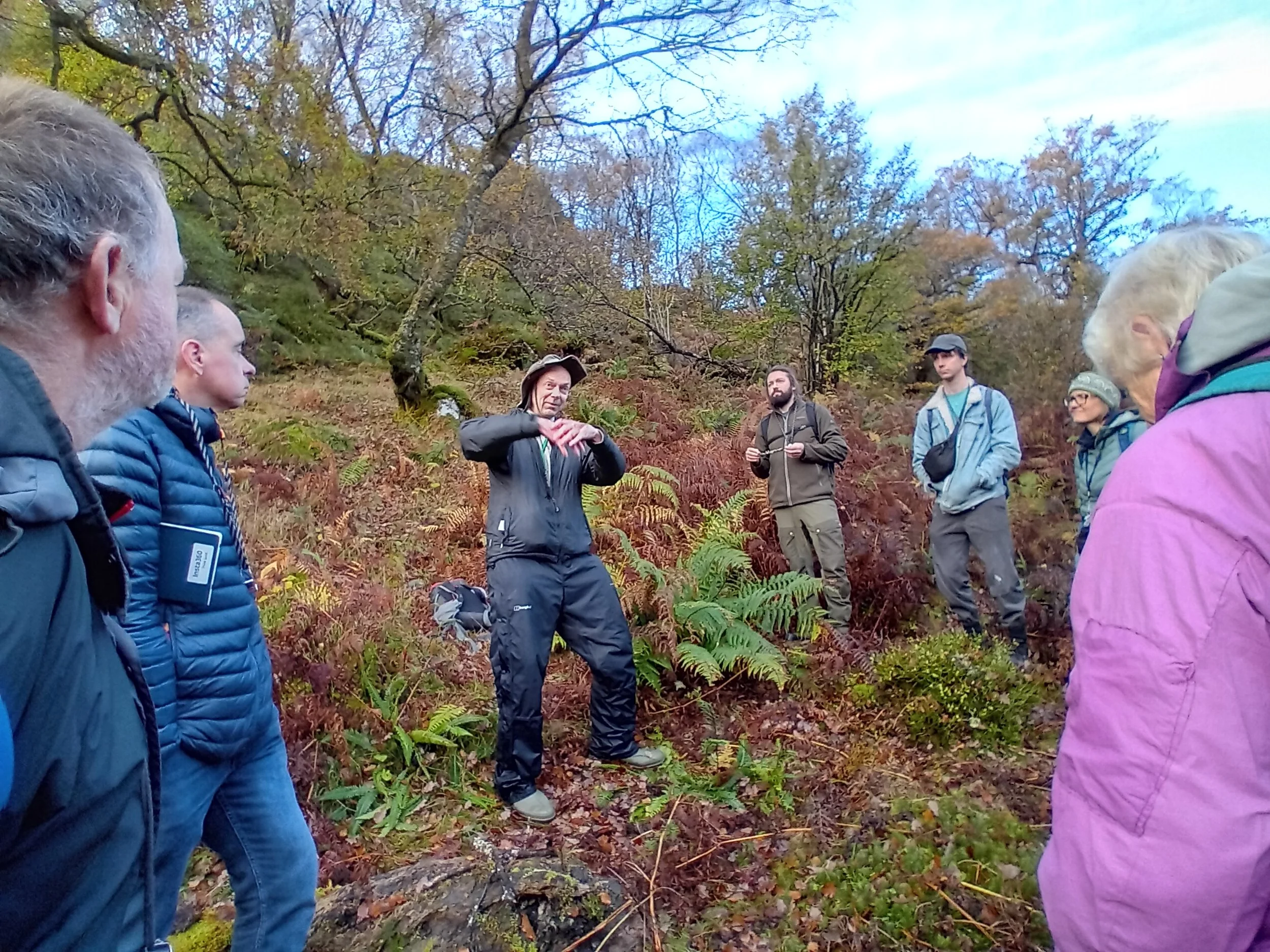
Oliver Moore runs a workshop in the Trossachs. Credit Craig Whyte
Temperate rainforest can be found up and down the west coast of the UK, but the largest and most biodiverse areas are in Scotland. Even here, most of the remaining rainforest fragments are restricted to an area that extends from the Mull of Kintyre to Cape Wrath, and from Skye to Loch Lomond.

Map showing the rainforest zone, and ASR projects
That’s why the Alliance for Scotland’s Rainforest (ASR) operates inside such a specific ‘rainforest zone’. With limited resources, it needs to focus on the areas with the most remaining fragments of rainforest, as that’s where the greatest potential is for successful long-term restoration.
But that’s not to say the ASR doesn’t work with groups and organisations ‘over-the-border’.
One of these is the Great Trossachs Forest (TGTF), Scotland’s largest National Nature Reserve. It overlaps the rainforest zone at Loch Lomond on its western fringes, then stretches away east to Bochastle near Callander, which is outside the zone.
The woodlands of TGTF are a mix. Areas of oaks, and birch grow alongside stands of historic conifer plantations, many of which are being removed and replaced with native species. Lots of tree planting has been taking place over the last 20 years through the TGTF project, and over time, continued planting and natural colonisation will increase woodland cover and connect surviving islands of ancient woodland.
Given the climate conditions in the area, it’s certainly possible that some of these new woodlands will eventually be classed as temperate rainforest – a definition that’s more about the lichens, mosses and liverworts than it is to do with trees. But this is likely to take many years, as bryophytes and lichens take a long time to establish.
In the meantime, rainforest guru Dr Oliver Moore, from Plantlife Scotland, has been helping TGTF by running workshops in the area. During these, he’s been revealing the secrets of the temperate rainforest’s sub-world, and the dazzling diversity of flora that hides in plain sight across the bark and branches of hazel, holly, birch and oak of the Trossachs’ ancient woodlands.
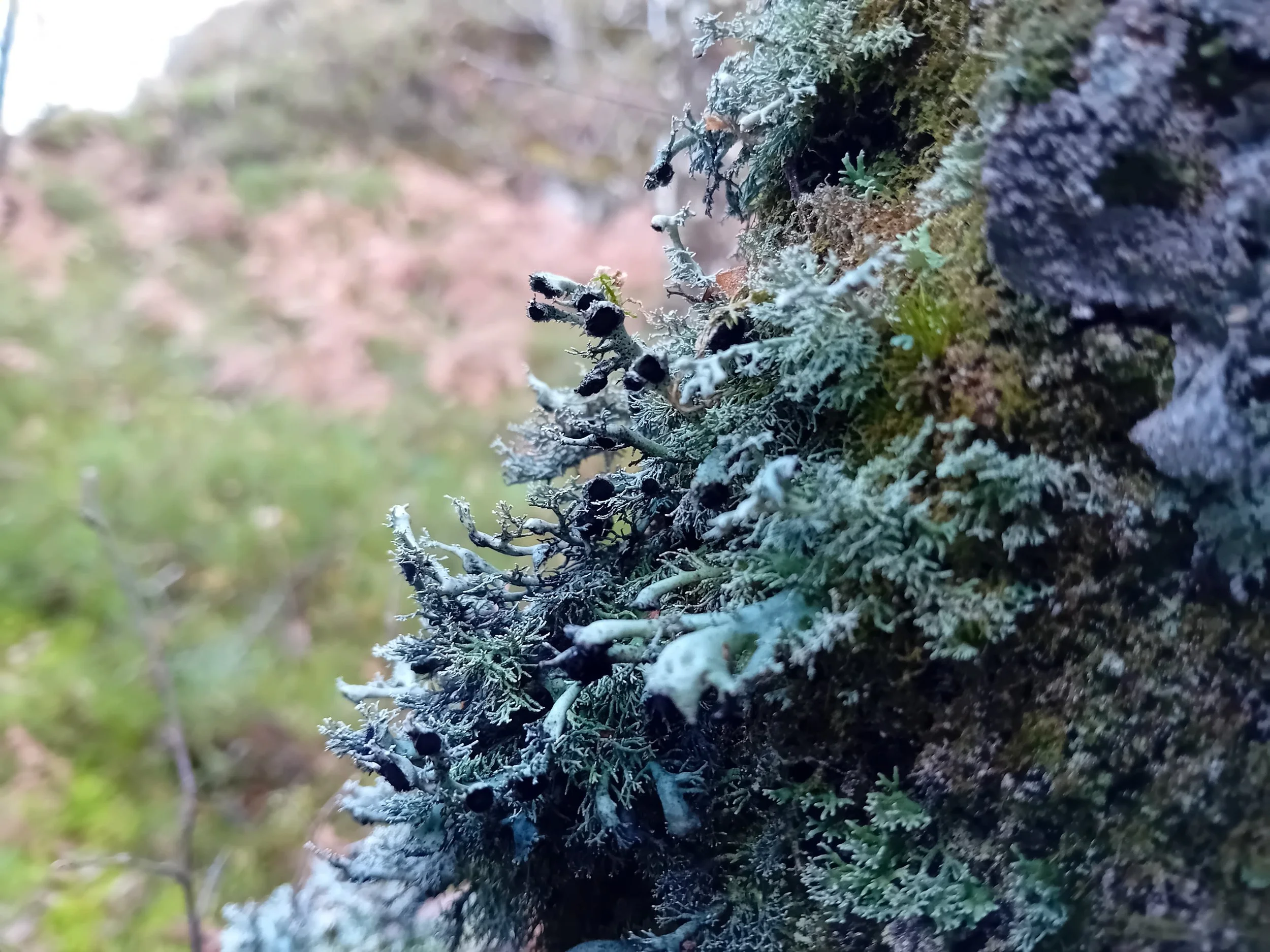
Black-eyed Susan lichen. Credit Craig Whyte
The hope is that workshop attendees, recent and future, will help to monitor the new woodlands, as well as the priceless survivors, where Oliver has already found several rainforest indicator species. As the young trees mature, hopefully some of these indicator species will start to spread, taking the ‘rainforest’ with them into new areas.
Further workshops are planned for the future, and who knows what Oliver may yet find.
