What is Scotland’s rainforest?
Introduction
What is Scotland’s rainforest?
Some temperate rainforest facts
Where is Scotland’s rainforest and what is the ‘rainforest zone’?
How much rainforest exists in Scotland?
Is it Scotland’s rainforest, temperate rainforest, Atlantic rainforest, or Celtic rainforest?
Do people live in Scotland’s rainforest?
Introduction
Scotland’s rainforest is one of our most precious habitats. It’s a coastal temperate rainforest that’s as important as tropical rainforest, but even rarer.
But Scotland’s rainforest is in trouble. As little as 30,000 hectares remain, and it faces many threats.
If we don’t start taking serious and urgent action to support and protect our rainforest, we risk losing this internationally important habitat completely. And the longer we wait, the harder it will become.
The good news is that communities and organisations up and down the west of Scotland are coming together to tackle threats to the rainforest, and help restore and expand surviving woodlands.
What is Scotland’s rainforest?
Scotland’s rainforest is temperate rainforest, a wet ecosystem usually based around woodland, that can only form where very specific conditions exist.
Scotland’s rainforest is full of wildlife, and home to rare mosses, liverworts and lichens that can’t survive anywhere else. These internationally important species are what makes Scotland’s rainforest so special. Without them a woodland isn’t temperate rainforest, no matter where it’s growing.
The conditions for temperate rainforest to form are found across just 1% of the world’s land surface, compared to the 15-20% where tropical rainforest could grow. That makes it a globally rare habitat.

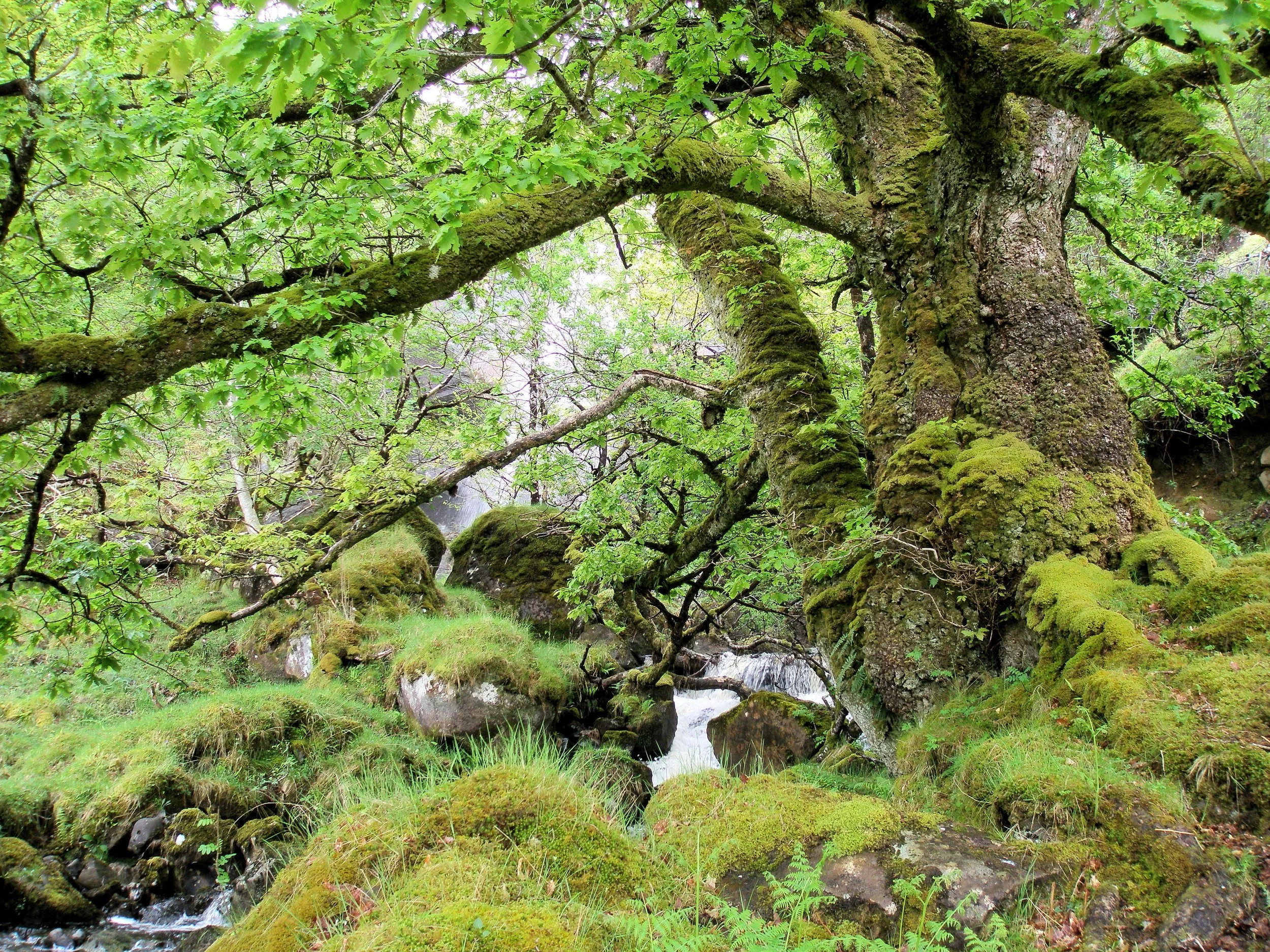
Beinn Eighe National Nature Reserve. Credit John MacPherson
Some temperate rainforest facts
Temperate rainforest can only grow where there’s high rainfall, over 1400mm a year. But it also needs rain right through the year. Long droughts are really damaging for temperate rainforest wildlife.
All of Scotland’s rainforest is found in the west. Our prevailing winds are westerlies, and they reach Scotland after travelling over the Atlantic and picking up lots of moisture. The first thing they hit is mountainous terrain, and this forces the water-laden air upwards, cooling it. As the air cools, it dumps much of its moisture as rain, so by the time the winds reach the east of Scotland, they’re much drier. Edinburgh gets about 700mm of rain a year. Parts of the west Highlands can get up to 4000mm: perfect for rainforest!

Temperate rainforest can only grow where the temperature is relatively stable throughout the year, between about 5C and 15C on average. They can tolerate hotter temperatures and frosts, but not for long periods. West Scotland is warmed in winter by the Gulf Stream and cooled in summer by wet winds off the Atlantic. East Scotland is less cloudy, so it tends to get more sun in summer, but is also exposed to the North Sea and air from Continental Europe in winter. This means it has greater weather extremes than the west.
Temperate rainforest can only thrive in unpolluted environments. Westerly winds from the Atlantic are usually free of pollutants, and there’s less intensive agriculture in West Scotland.

Temperate rainforest needs high humidity. This is created by the temperature, the rain, streams and rivers, the canopy of a mature woodland holding in the moisture, and the thousands of mosses, liverworts and lichens, which act like living sponges.
Temperate rainforest is old-growth woodland with ecological continuity. This means it’s been where it is for hundreds of years in a relatively undisturbed state. That doesn’t mean it’s been in some sort of bubble; nature is dynamic and there have always been storms, floods and fires. People and animals will also have interacted with the woodland in some way. But rainforest lichens, mosses and liverworts grow very slowly, so they need time to form. Too much disturbance, and they often can’t survive.
Ironically, too little disturbance can also be damaging to rainforest habitats! Natural woodlands would always have had deer and other species nibbling away at the undergrowth and preventing it getting too dense. In our managed woodlands of today, a careful balance of grazing needs to be found.
Temperate rainforest is never just trees: it always includes a special mix of rare lichens, mosses and liverworts. But it isn’t even necessarily woodland. The habitat is centred around woodlands, but includes surrounding treeless habitats, such as woodland glades, river glens and gorges, and even individual boulders. Isolated trees outside of woods can also be considered part of the rainforest, if they host indicator species.
Most of the world’s temperate rainforest grows in Canada and the US, but you’ll also find it in Chile, Russia, New Zealand, Norway and Japan.
Canada has roughly 1000 times more temperate rainforest than Scotland. However, although tiny in comparison, Scotland’s rainforest is internationally important for the sheer number and variety of specialist wildlife that it supports, particularly mosses, liverworts and lichens. In global terms, our rainforest really punches above its weight!
Where is Scotland’s rainforest and what is the ‘rainforest zone’?
Temperate rainforest can be found up and down the west coast of the UK and Ireland, with notable patches in Wales, Devon, Cornwall and Cumbria.
However, the largest and most biodiverse areas of temperate rainforest in the whole of the UK are all in Scotland.
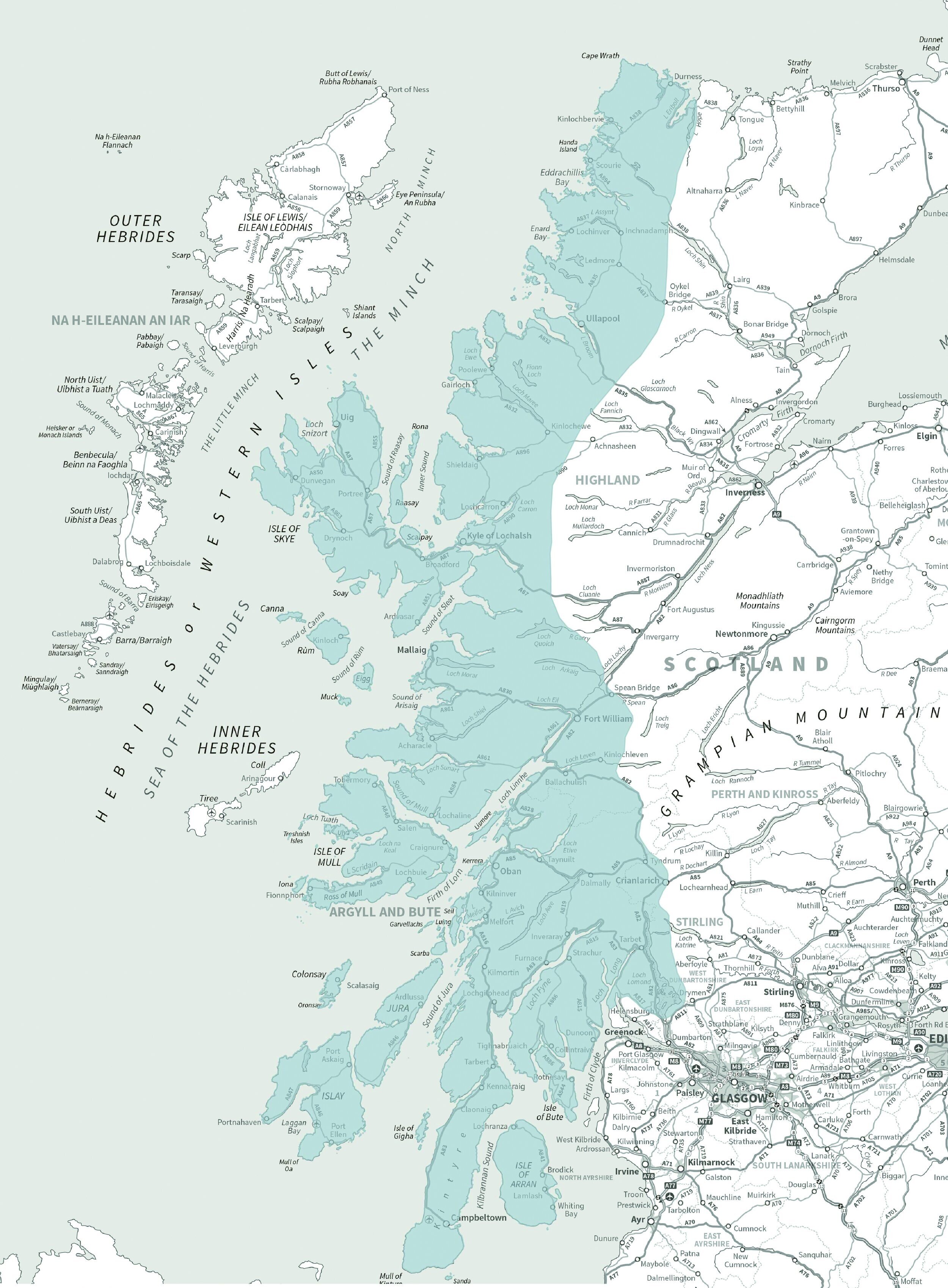
Here, the richest rainforest woodlands are found in an area that extends from the Mull of Kintyre to Cape Wrath, and from Skye to Loch Lomond. It includes most of the Inner Hebrides, but not the Outer Hebrides. We call this Scotland’s rainforest zone, and it’s 1,853,900 hectares in size!
Looking at a map of the zone, it’s easy to be confused into thinking that either a) the whole area is currently covered in temperate rainforest, or b) the entire area could one day be covered in temperate rainforest. Neither is true.
The rainforest zone is simply the area in Scotland where the right conditions can be found for temperate rainforest to form and grow. Very little of it is currently rainforest, and a lot of it would never be suited for rainforest (eg exposed mountainsides, upland moorland). Rainforest is very particular about where it will grow.
All the collaborative work of the Alliance for Scotland’s Rainforest’s takes place inside the rainforest zone. With limited resources, we need to focus on the areas where there’s the greatest potential for successful long-term restoration.
That doesn’t mean there isn’t temperate rainforest in other parts of Scotland. There are fragments in Dumfries and Galloway, and east of Loch Lomond in the Trossachs, Perthshire and southern Highlands. Maybe one day the work of the ASR will expand to include these areas, but for now we think our limited time and resources are best focussed on the zone.
How much rainforest exists in Scotland?
It’s estimated that just over 30,000 hectares of temperate rainforest survive in Scotland today, that is woodlands and other habitats that are known to support good numbers of rare mosses, liverworts and lichens.
It isn’t all joined up, but is fragmented up and down the west of Scotland. While some areas are very large, the majority are very small, with a median of around 25 hectares. In total, it makes up about 1.6% of the rainforest zone.
It can be hard to visualise 30,000 hectares, so here are a few helpful comparisons:
Edinburgh is 26,400 hectares.
Islay is 61,956 hectares.
Scotland’s largest single wildfire at Carrbridge and Dava Moor in 2025, burned 9,752 hectares.
It’s about 42,000 football pitches or 56,000 rugby pitches!
This 30,000 hectares figure is an estimate as there’s no technology that allows us to precisely map different habitats across Scotland. So how was it reached?
In 2010, Plantlife modelled the extent of rainforest in West Scotland, based on historic maps and modern surveys showing sites known or likely to contain rainforest indicator species.
A second survey, called the Native Woodland Survey of Scotland, was conducted between 2006 and 2013 by Forestry Commission Scotland (now Forestry and Land Scotland (FLS)). This showed that there were 92,863 hectares of native woodland within the rainforest zone.
The estimate of 30,000 hectares was reached by combining the findings of Plantlife and FLS, but there are gaps in the data. Work is on-going to try to reach a more accurate picture, so that figure of 30,000 could increase. But we’re also losing rainforest to numerous threats, so the figure could go down as well.
Either way, there are another 63,000 hectares (about the size of Islay…) of native woodland in the west of Scotland that have the potential to be temperate rainforest but currently lack the biodiversity. As well as protecting existing rainforest, it’s important to protect these other woodlands as well. It’s easier and quicker for rainforest biodiversity to spread into existing, well-managed woodland, rather than waiting hundreds of years for newly planted trees to grow and mature.
One other important thing to note is that this 30,000 hectares includes about 6,500 of what are called Plantations on Ancient Woodland Sites, or PAWS. These are areas where native woodland has been chopped down and replaced with conifer plantations.
They might seem an odd thing to include. But they often contain significant remnants of rainforest biodiversity in surviving veteran trees, or in buffer zones of native woodland left along water courses. If sympathetically restored, they could in time become valuable rainforest habitats once again.

Tree nursery, Lochaline. Credit Jenny Tweedie
Can you plant a rainforest?
No.
Temperate rainforests are a product of hundreds of years of formation, like biological stalactites slowly dripping themselves into being.
A tree within a rainforest woodland will likely be covered in a complex tangle of filmy ferns, fungi, lichens, mosses and liverworts, which will all be growing over and on each other. The hazel-gloves fungus, for example, can only grow on top of another fungus, called the glue crust fungus, which only thrives where it can stick two hazel branches together and slowly start to feed off them. Polypody ferns found in the rainforest grow out of mosses that are growing on the branches of mature trees – in most other woodlands they grow on the ground.
For all our ingenuity, humans simply can’t replicate this natural process of interaction, coincidence, chance, rain and time.
But, we can occasionally help it along. In areas where we know (or can take an educated guess) that rainforest once thrived, we can plant native trees which will eventually become a woodland. This has the potential to be rainforest but only if:
Conditions are right (enough rain, stable temperatures etc)
There are rainforest fragments nearby, eg a small group of veteran trees that have rainforest lichens and liverworts on their bark, often called rainforest ‘refugia’. Over a long time, these species would hopefully spread by spores, or other means, into the new woodland.
You’re prepared to wait a long time. How long? Hard to say, but at least 100 years.
With this in mind, tree planting can be a part of rainforest restoration, as it allows conservationists to ‘fill in the gaps’ of missing woodland, and replace missing species from areas they were historically removed.
BUT natural regeneration is far more important for the long-term survival of Scotland’s rainforest, and it’s crucial that we protect the rainforests we still have before rushing to plant ‘new’ ones. Newly planted woodlands are also, sadly, more at risk from wildfires than mature woodland, an issue which is becoming a growing threat in Scotland due to climate change.

Ballachuan hazel wood. Credit John MacPherson
Is it Scotland’s rainforest, temperate rainforest, Atlantic rainforest, or Celtic rainforest?
The ASR always uses Scotland’s rainforest or temperate rainforest to describe this habitat, but you might see it called by other names. Let’s try to break this down.
Atlantic woodland
For decades, scientists have been using the term Atlantic to refer to the wet woodlands of west Britain. Basically, it’s just a description of the wet, humid conditions found in geographical areas that are influenced by the Atlantic Ocean. The term is often used along with the type of tree that dominates a particular woodland, such as oak or hazel (Atlantic oak woodland etc).
Until about 2015, Atlantic woodland was the main term being used for the wet woods of west Scotland, and in fact, the original name for the ASR was the ‘Atlantic Woodland Alliance’. However, the terms Atlantic and temperate rainforest are not entirely synonymous. Atlantic woodland is any native woodland within the wetter west. What we call temperate rainforest has a more specific definition, and it includes areas that aren’t woodlands, such as ravines covered in mosses and liverworts.
You’ll still see Atlantic woodland in use, and the ASR will sometimes use it to refer to specific woodland habitats. You’ll also occasionally see the term Atlantic rainforest as a sort of hybrid between the two, but that’s not something we use.
Because just to confuse you further, Atlantic rainforest is also a type of rainforest found on the east coast of South America…
Hyperoceanic woodland
While Atlantic woodland is a bit of a generic geographic term, hyperoceanic is very specific ecological term. As the name implies, it refers to woodland that is extremely influenced by the ocean (in our case the Atlantic) in terms of rainfall, temperature, and humidity. Hyperoceanic can also be used to describe the lichens, liverworts and mosses that grow in these conditions.
Hyperoceanic woodlands are at the core of what we now call Scotland’s rainforest. You’ll often see this term being used in a scientific context.
Celtic rainforest
This term was briefly used in Scotland, and you’ll still see if popping up from time to time. It’s also used to describe the temperate rainforest found in Wales and sometimes Ireland as well.
Scotland’s rainforest or temperate rainforest?
Temperate rainforest is a global ecosystem that’s defined by high rainfall, high humidity, and stable temperatures. Scotland’s rainforest is temperate rainforest that grows in Scotland. It’s as simple as that.
We would encourage everyone talking about this habitat to use Scotland’s rainforest or temperate rainforest.
Note that Scotland’s rainforest has a lower case ‘r’ as it’s not a proper noun.
The more we can use clear and consistent language to talk about this habitat, the easier it is for people to learn about and understand.
Use all the terms together
Hyperoceanic lichens and liverworts are often found in the Atlantic oak woodlands of Scotland’s rainforest. These woodlands are part of a global ecosystem called temperate rainforest.


Do people live in Scotland’s rainforest?
Of course! You won’t find rainforest in the populous central belt of Scotland, but thousands of people live across the rainforest zone, and the rainforest is very important for these communities, as it has been for millennia.
Once it would have been a foraging haven for nuts and berries, and a hunting ground for deer and wild boar, as well as a source of wood for fuel and building material. Farmers will have grazed their cows, horses, sheep and goats in wood pasture, creating a more open habitat with clearings.
The iconic oak woods were shaped by coppice management in the 18th and 19th centuries, mainly to produce charcoal for the iron industry and bark for tanning in the leather industry. Because oak was the best kind of tree for both purposes, it was favoured above other species, which is why these woodlands tend to be so oak-dominated.
Birch was used extensively by the textiles industry, which used the wood to make cotton reels and bobbins. Even lichens were harvested for making dyes, particularly a lichen called a cudbear, which was taken in huge quantities.
These industries are all gone now, but today, many people who live in the rainforest zone have employment that’s linked to these wild places, through woodland management, tourism, sporting estates, farming or crofting. These woodlands also have an impact on the wider environment through protection against flooding and soil erosion, provide a health and wellbeing space, and are an important cultural heritage link with the past.
The close involvement of the communities who live and work in Scotland’s rainforest zone today is absolutely crucial for securing the long-term survival of this habitat.

Lichens and bryophytes. Credit Gus Routledge
Why is Scotland’s rainforest worth saving?
This is quite a broad question!
A simple answer would be that it’s one of the world’s rarest habitats. Scotland holds the highest quantity and quality of temperate rainforest in all of Europe, and it contains species found in few or no other places. We have an international responsibility to look after these ecosystems for the benefit of the people of Scotland, and for the future generations that come after us.
Other answers would depend on how you ‘value’ nature.
It’s worth saving for its own sake
This is a stunningly beautiful habitat, that’s dripping with life. Everywhere you look there’s a different lichen or moss, a different twisted tree thriving through everything the Scottish weather throws at it. Rare butterflies flit through the air; rare birds nest hidden away in the branches. It’s a joy to walk through, inspiring art, music, photography and crafts. Why wouldn’t you want to save it?
What would replace it?
If the rainforest was gone, it’s likely that some land would become bare, some would be replaced with conifer plantations, and some would be replaced with invasive non-native species, like Rhododendron ponticum. None of these bring the environmental or cultural benefits of rainforest, and could have a detrimental impact for the communities that live in these areas.
Biodiversity is crucial for life
Temperate rainforest is one of the most biodiverse habitats in Scotland. Preserving biodiversity on a global scale is essential because it forms the fundamental life-support system that ensures human survival, food security, and economic stability.
Diverse ecosystems provide ‘eco-system services’ like clean air, climate regulation, water purification, and crop pollination. They also serve as a natural pharmacy responsible for over half of modern medicines. Lichens, for example, contain over 1,000 known chemical compounds that help them withstand extreme environmental conditions. Many of these are actively being studied because they show antibacterial, antiviral, anti-inflammatory, antioxidant, and even anticancer properties.
When an ecosystem loses species, it loses its resilience, making it more vulnerable to collapse from wildfires, disease, and climate change.
Ultimately, protecting biodiversity is both a practical necessity for safeguarding our resources and a moral obligation to protect the inherent right of all species to exist.
By wishing to protect, restore and expand Scotland’s rainforest we are also making a significant contribution in tackling the global nature crisis.

What is being done to save Scotland’s rainforest?
Individual rainforest woodlands across the west of Scotland have long been valued. However, in the late 2010s, concern for individual sites evolved into a drive to recognise the importance of the wider ecosystem that these woodlands belonged to: temperate rainforest.
At this point, conservation organisations formed a partnership with the aim of joining up work to protect and restore this ecosystem on a landscape scale. This partnership is now the Alliance for Scotland’s Rainforest, a network of over 40 organisations.
ASR organisations are working across the rainforest zone doing all kinds of management to restore and expand Scotland’s rainforest, both within collaborative, landscape-scale projects and their individual landholdings.
