

Volunteering on Carna
Following on from our last blog about invasive non-native species, Kezia Lavan, an RSPB Scotland volunteer, talks about her personal experience of helping to remove Rhododendron ponticum from a remote Scottish island.
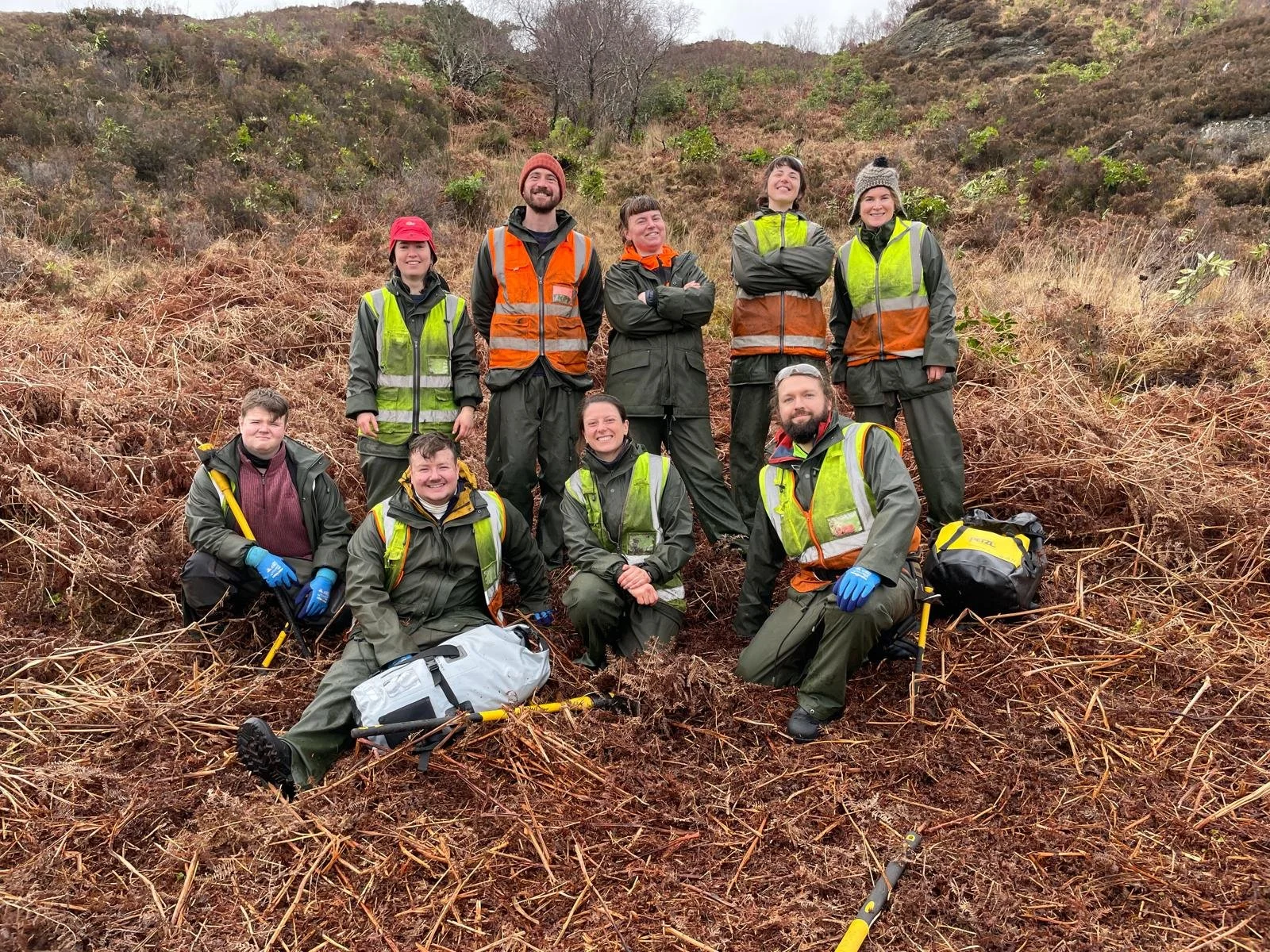
Volunteers on Carna
Six weeks of hard physical labour removing rhododendrons on a Scottish island at the coldest time of year beckoned. ‘Are you sure about this?’ my friends had asked.
As I wobbled on the remains of a floating pontoon, wrenched from the shore in October’s record-breaking storm, the windswept and lonely mass of the Isle of Càrna reared up before me. Stumbling awkwardly onto jagged rocks on a seaweed-covered shore, the ice-cold waters of Loch Sunart lapping at my feet, their words echoed in my head. With neither the much-anticipated otter, eagle nor pine marten in sight and the island’s weekly ferry receding towards the mainland, my heart sank.
What have I done?
This impression did not leave me as I struggled with grass tufts and peat-sodden soil to wrestle my first rhodi out later that day, nor as I battled the funnelling winds that changed direction every half hour. Twice the age of many of the other volunteers I wondered how I would ever keep up.
I had never seen a mattock before (a double-headed metre-long metal tool for cutting roots and breaking soil) let alone wielded one on an exposed hillside. My hapless hacking at the heather was mercifully remedied by kind RSPB staffer Ruth, who patiently coached me in effective mattock throwing. With knees bent, gravity bringing the weight down and hands sliding to reduce impact, my mattock swing soon became more powerful, less exhausting and much kinder on the joints. Perhaps I could do this!
Why Rhododendron ponticum is being removed
In partnership with local landowners, the RSPB is working to preserve and restore the unique temperate rainforest in Morvern and beyond. These woodlands are relics of what was once much more extensive temperate rainforest found across the seaboard of west Scotland.
The Isle of Càrna is one such place. Measuring less than a square mile and nestling between the remote peninsulas of Ardnamurchan and Morvern, Càrna is home to hundreds of rare and internationally important lichens, mosses, and liverworts. In common with much of the region, invasive Rhododendron ponticum has taken hold, poisoning soils, choking and shading other species and changing the microclimate, threatening the diverse rainforest wildlife and flora.
Emblematic species such as otters, pine martens, woodcocks, seals and pied flycatchers make their home here, while golden and white-tailed eagles visit regularly. Clearance of the sometimes vast and stubbornly rooted rhododendron is essential if these rainforest fragments are to thrive, the seeds are to be prevented from spreading further, and natural habitats protected.
How to dig up a rhododendron
Digging the rhododendron root out required different techniques for distinct conditions, I soon discovered. Incredibly adaptable and resilient, the invaders seemed intent on making my life difficult, wrapping themselves around birch roots, embedding in heather clumps or disappearing into a rock crevice.
Understanding and persuasion are essential to coax out a difficult rhodi. Too much yanking or hacking and the risk is a sore back and a detached root bulb, leaving the rhododendron to grow back even stronger the next year.
Alasdair from the RSPB deftly revealed the secret – dig a trench around the plant, gently wobble the thickest stem until you can feel the direction of growth, and then lever at the point of least resistance. And with a welcome squelch out comes the rhodi! A few enjoyable minutes whacking turf off the sodden mass and the prize is revealed – a root bulb complete with the bright pink spurs that allow it to spread so voraciously.
Despite my initial misgivings, my physical abilities gradually improved and by the third week I was keeping up with my fellow-volunteers, festooning the trees around me with upside-down rhodi roots, carefully placed to allow the roots to dry and prevent the dreaded regrowth.
Planning, checks and avoiding otters
Each day the friendly and well-organised RSPB team identified a location strategic to rhodi control and the daily weather conditions. Otter survey maps were carefully consulted to avoid disturbance and a health and safety checklist run through, extra equipment brought along if necessary.
On calm days, we would head to a rhodi-covered hill leading up to Carna’s highest peak. Here, white-tailed eagles swooping above our heads made a welcome distraction from mud and roots, and tea breaks were spent gazing over the loch towards the ever-changing sometimes snow-covered massifs of the mainland.
Lunch breaks in the rugged northwest revealed distant Coll on a clear day, with noisy munching of sandwiches sometimes broken by the appearance of an otter on the shoreline.
One particularly damp day we traversed thick undergrowth to reach ‘Goblin City’, a rocky cliff where a dense rhodi forest or ‘complex’ flowed through an enchanting maze of caves and moss-covered boulders. Here, we took shelter from the rain under the umbrella-like structure of mature plants, ungratefully removing ‘layered’ branches whose roots had further anchored the bush into the ground. Once the layers were removed, the root ball would be identified, exposed and prepared ready for treatment. By the end of the day, we were muddy, exhausted and happy. Goblin City would soon exist only in myth.
It’s important to take some time off to explore
As a volunteer, I enjoyed a very welcome three-day weekend to wander the island and recover from the unfamiliar physical work. Dominated by steep gulleys, caves and rocky outcrops in the interior and fringed with a mixture of cliffs, bays and beaches, exploring Carna could be an experience as frustrating as it was breathtaking.
Having progressed at little more than one mile-per-hour through tangled grasses, gnarly tussocks and peat bogs deep enough to lose a welly, I sat down with my cup of tea on a wet and windy cliff. Watching the play of the ever-changing light on the channel below, I noticed tiny white flashes breaking the surface: a pod of nine common dolphins breaking the surface in a mesmerising rhythm.
My planned circumnavigation of the island got no further that day. Likewise, with eyes, fingers and nose newly alive to the hidden world of lichens and liverworts, I could no longer pass an old oak without stopping to admire the fruiting bodies, strange smells and organ-like structures of stinky sticta, jellyskin lichen and tree lungwort. Those RSPB experts and their enthusiasm had a lot to answer for!
Even my birthday was an adventure. It was almost ruined by the apparent absence of a much hoped-for otter that day. But then I happened upon not one, but three: a mother and two pups splashing from one loch shore to the next, each emerging from the water in turn to rest on the skerry above. So much for entitlement to extra birthday cake!
Reflection on volunteering in Scotland’s rainforest
When I arrived on Càrna in the depths of winter, a terrifying and bleak landscape confronted me. I was the oldest volunteer and a bit out of shape. It was so cold that even the friendly highland cows woke up covered in frost one morning. When I left, yellow flag iris was beginning to peep through, gurgling springs hinted at warmer weather and stonechats were chatting in spring best.
I volunteered for the RSPB for many reasons, but mainly because I knew I needed a change after a difficult redundancy. It worked. Mornings dragging a heavy mattock uphill in wellies, hours facing-down rhodi roots, hands plunged deep in the soil, exposed to cold and rain (but warm and dry in my RSPB-issued waterproofs) gave me the time I needed to let thoughts, worries and accumulated sadness bubble up, pass through and leave.
I think I enjoyed it more than the rhododendrons did. There are a lot less now than there were. They won’t be back, but I am.
